
Finding Kingston Residents Through Records
No single open list names every person living in Kingston right now. That is the first thing to accept. The best starting record depends on the question you bring. Addresses anchor firmly in the county GIS and the assessment rolls. A known owner or a transfer date leads instead to the county clerk's deed records. Older households show up more often in a dated city directory. They also appear in a newspaper item or an old map. Voter registration, meanwhile, is a narrow election tool demanding exact name matches. That makes it work poorly as a general residents directory. Whatever the source, keep the result tied to its date. A directory listing, a deed party, a mailing address, and current occupancy are four different facts. Confusing them is the fastest way to a wrong conclusion.
Address questions deserve the property route first. Each parcel record separates the situs from any mailing address the county displays. The situs is the physical location of the property. That split matters. It stops you from reading a correspondence address as proof that someone actually lives there.
- Normalize the street with the USPS ZIP Lookup, then retain the returned delivery form.
- Search the Ulster County Parcel Viewer by address, owner name, or parcel number and save the query date.
- Compare the parcel with the Kingston Assessor roll for its owner-of-record, roll year, physical facts, exemptions, and separate mailing field.
- Follow the parcel or address into Ulster County land records for the deed chain and its recorded dates.
- Use a dated directory, repository, or a focused records request only after the address and period are clear.
Note: An empty result in any Kingston residents directory search does not prove a person never lived at that address.
Kingston Resident Records Offices
Four offices cover most official routes into Kingston resident research. The City Assessor ties an assessment record to a parcel. The Ulster County Clerk keeps recorded land instruments. The Board of Elections runs registration tools and lawful file requests. The City Clerk/Registrar holds the local vital-record functions. Their holdings overlap, but each answers a different question. Go to the custodian that created the record. Then use its counter, phone, mail, or online route whenever the public interface does not expose the document you need.
City of Kingston Assessor
City Hall, 420 Broadway
Kingston, NY 12401
845-334-3910
Ulster County Clerk Land Records
244 Fair St., 2nd Floor
Kingston, NY 12401
845-340-3288
Ulster County Board of Elections
79 Hurley Ave., Suite 112
Kingston, NY 12401
845-334-5470
Kingston City Clerk and Registrar
City Hall, 420 Broadway
Kingston, NY 12401
845-334-3914
Access channels differ from office to office. The assessor links to rolls and maps. It also offers a mailing-address correction route. The clerk provides online land-record paths along with counter access. Election requests follow the Board's stated process. Vital-record access turns on eligibility, identification, and certificate rules rather than any general name search.
Kingston Parcel Viewer Search Fields
The county parcel viewer serves as Kingston's practical geographic index. It takes an owner name, an address, or a parcel number. A broad query can come back empty. The county then suggests narrowing to a last name, a street name, or a section-block search. Selecting a result opens map information. It also links to complete parcel information, street-level imagery, and aerial imagery. The viewer can also select several parcels. You can buffer them, export the selected data, and print an 8.5-by-11 map. Treat these tools as a dated research aid, though. They are not a surveyed boundary, and they are not an occupancy record.
| Viewer field | How it is used | Result to retain |
|---|---|---|
| Owner name | Try the last name when an address is uncertain. | Query form and selected parcel |
| Address | Locate a property after USPS normalization. | Situs and parcel number |
| Parcel number | Connect the map result to assessor and deed records. | Identifier and map date |
| Section-block | Narrow a street or owner query with too many results. | Applied geographic filter |
| Map selection | Review complete parcel, imagery, or nearby parcels. | Layer state and export date |
The assessor's Image Mate assessment entry opens one public route into countywide assessment records.
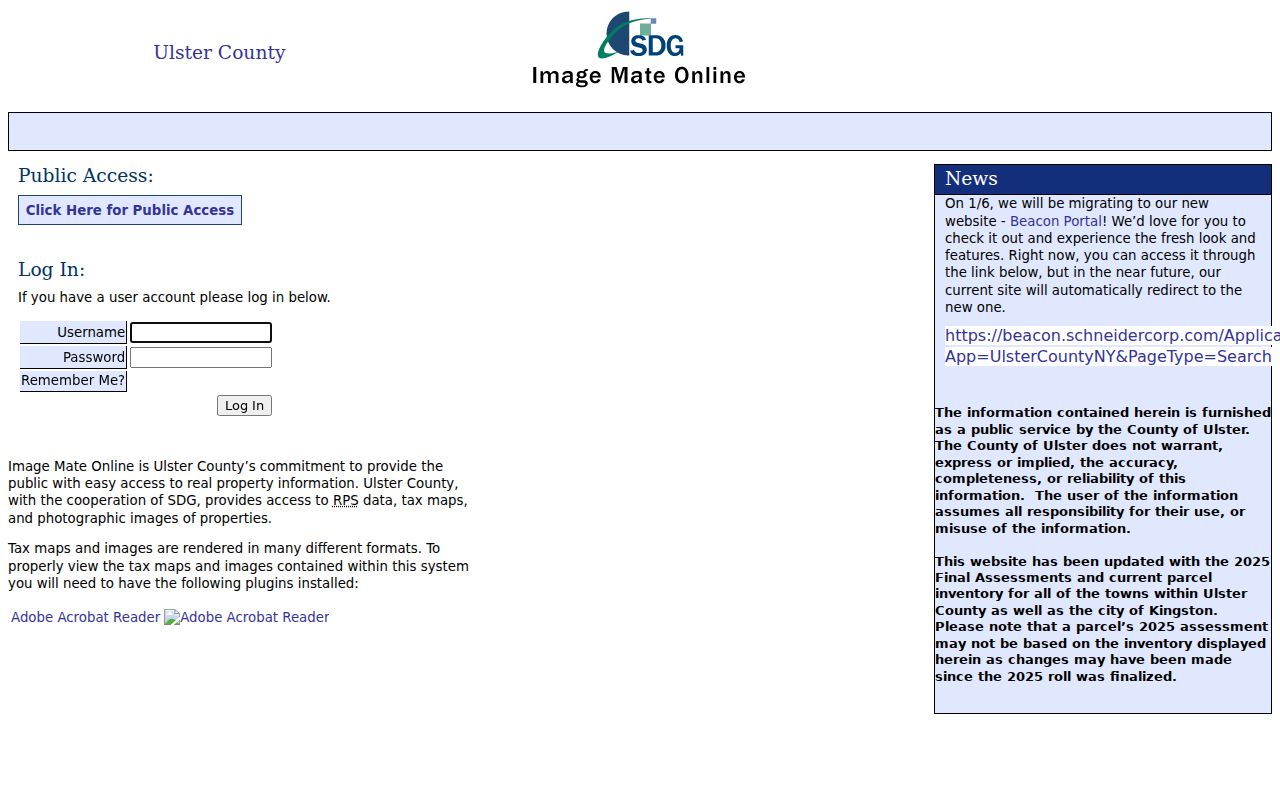
Assessment information can describe style, year built, size, age, condition, ownership, and exemptions. Its owner field, however, is tied to the roll date. The county's Parcel Viewer displays the search, map, selection, and export controls that connect a street address to a parcel.

Note: County notices list January 1, May 1, and September 1 updates, so retain the map date.
Reading Kingston Property Records
Read a Kingston property record as a chain, not a single answer. The assessor gives you a roll-year snapshot. The county clerk's land records run from 1685 to the present. SearchIQS covers 1950 to current records, and INDEXBOOKS covers 1949 and earlier. Documents before 2003 use book and page references, while later ones use instrument numbers. Search both grantor and grantee sides. Then follow prior references and the legal description. A deed establishes a recorded transaction. An assessment record can corroborate the parcel and a later roll.
- Parcel
- A tax or GIS identifier that connects a physical property to assessor and map records.
- Situs address
- The physical location of the parcel, distinct from a correspondence or mailing field.
- Grantor and grantee
- The parties named in a recorded transfer, generally the transferring and receiving sides of an instrument.
- Index
- A finding tool that points to a record reference or image. It is not the certified record itself.
For a recent deed, the clerk's 2025 house-history instructions say to open guest search. Choose Deeds in Document Group. Enter Book and Page. Then use Search and View. The guide shows a cover page, a summary, page arrows, and Print/Download controls. Recent image access requires a credit card for that search session. The online route may not reach an older volume you need. Contact the clerk in that case rather than assuming the document was never recorded. Note: A mailing address, a parcel boundary, and an owner field each need a source date and context.
Kingston Voter Lookup Boundaries
New York's Voter Lookup presents itself as a poll-site tool. But it doubles as a resident lookup for Kingston. The form asks for County, Last Name, First Name, and Date of Birth in MM/DD/YYYY format. It also asks for ZIP Code and Search. Cookies and JavaScript have to be turned on first. Whatever you type must match the registration record exactly.
A search that comes back empty can mean several things. A spelling difference will do it. So will a changed registration, odd address formatting, or a protected record. Treat the miss as a puzzle, not a verdict. It is not proof that someone is absent from Kingston.
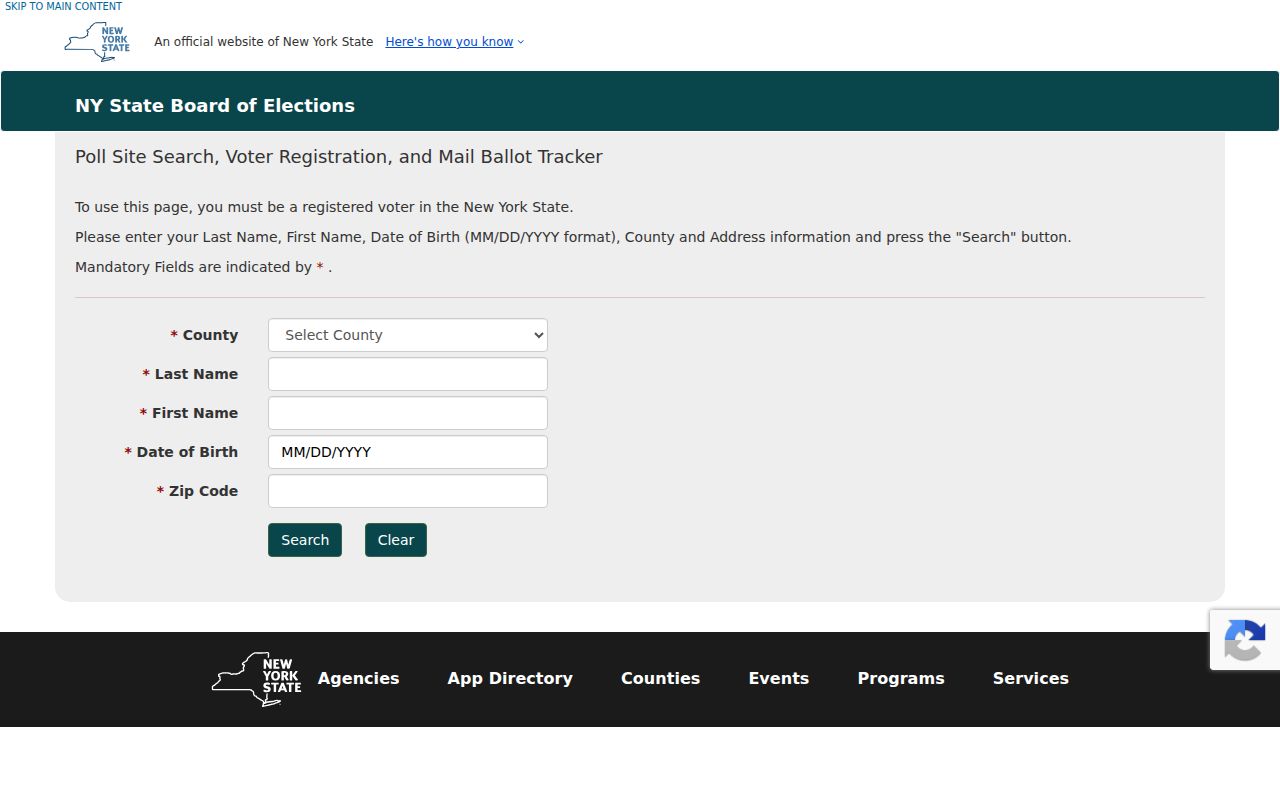
The state Voter Lookup shows the fields a registered New York voter enters for the limited registration and poll-site search. That route is quick. It is also narrow.
A file request works differently. The Ulster County Board of Elections asks for the requester's details, a scope defined by political subdivision and party where that applies, and the election-purpose statement required by Election Law §3-103(5). The signed request goes to the Board by mail. Public inspection and the web lookup are separate access paths, and confidential registrations stay outside ordinary inspection.
Current Kingston Resident Directories
No single roll lists everyone in Kingston today. Instead, the residents directory landscape is a set of partial directories. Each one records a different activity or administrative relationship. The GIS and assessment systems track parcels and owner-of-record details. Land records name the parties to recorded instruments. The election route answers registration questions under its own rules. Court tools can point to a case path. Yet the clerk keeps authority over anything missing, protected, or certified. Pick the source whose field actually answers your question. Then keep its date and its limits with the answer.
| Current source | What it can locate | Custodian | Access route |
|---|---|---|---|
| Parcel Viewer | Parcel, situs, map context, and selected data | Ulster County GIS | Free owner, address, or parcel search |
| Assessment roll | Owner-of-record, physical facts, exemptions, and mailing field | Kingston Assessor | Roll, parcel route, office, or focused request |
| Voter route | Registration and poll-site information for an exact-match lookup | NYS and Ulster elections offices | Lookup or signed lawful file request |
| Land-record index | Recorded deed, mortgage, lien, and instrument parties | Ulster County Clerk | Online index, counter, or correspondence |
| Local court tools | Selected party, index, calendar, and court information | NYS Unified Court System | Web route followed by clerk access when needed |
A property roll is not a resident list. A historical directory is not proof anyone lives somewhere now. The dependable method compares records made for different purposes, with their dates kept separate. A court result may be incomplete online, and vital records carry eligibility rules. Those limits are part of a solid Kingston resident lookup, not a reason to fill the gaps with guesses.
Kingston Records FOIL Path
New York's Freedom of Information Law sits in Public Officers Law Article 6, sections 84 through 90. A request has to describe an existing record. It cannot force a city or county office to build a new list of people. Records Kingston created go through the City FOIL route. County-created records belong with the county records-access officer. City 311 handles service requests, not FOIL.
- Name one record family, such as permits, inspections, a specific deed-related record, or a dated municipal file.
- Give the address, parcel number, historic place name if relevant, and a clear date range.
- Ask for electronic copies when reasonably available and request the reason for any withholding or redaction.
- Keep the submission, acknowledgment, fee estimate, and final response together.
For records the city created or holds, the City of Kingston FOIL submission entry is the documented starting point.
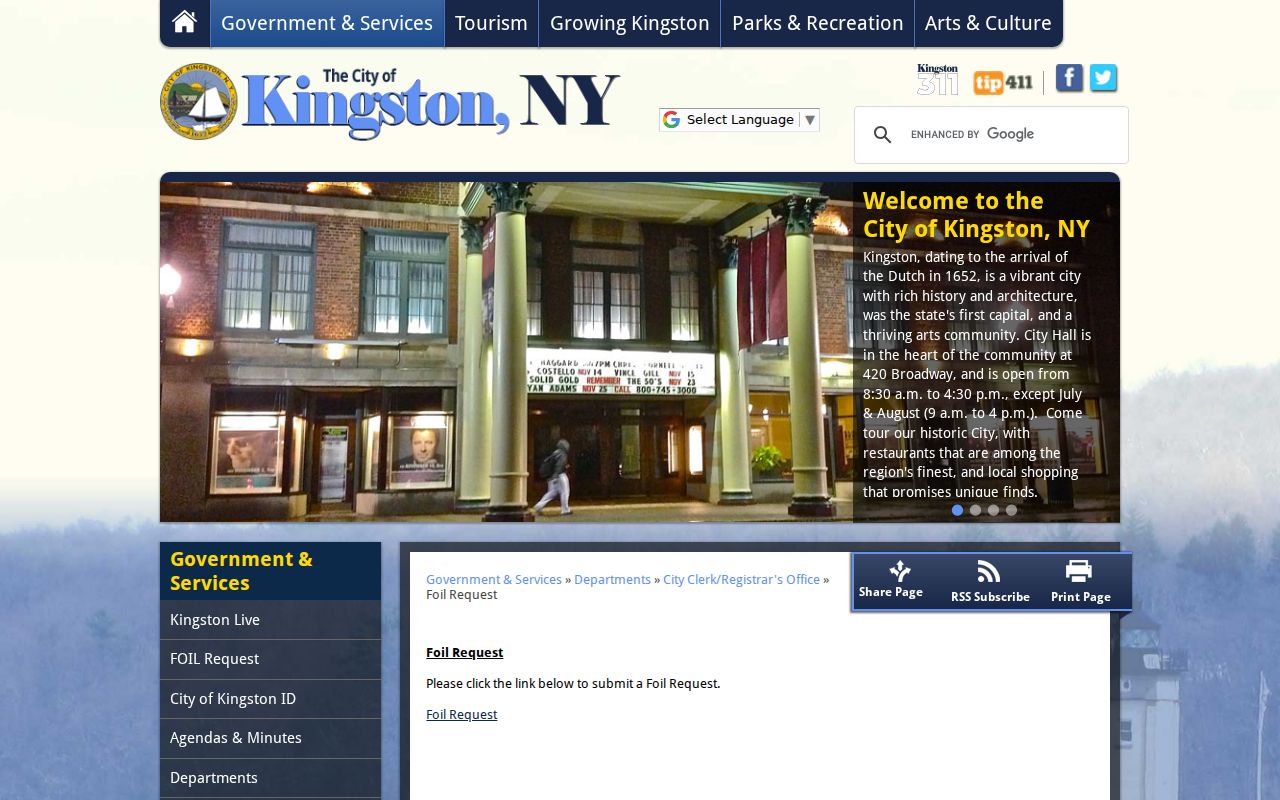
Statewide guidance gives agencies roughly five business days to grant, deny, or acknowledge a request. More time may be needed. Exempt material can be redacted. The standard copy rule is generally 25 cents per page up to 9 by 14 inches. Larger or specialized material is charged at actual reproduction cost.
Note: A focused request for one existing Kingston record works far better. It beats a demand for a new resident compilation.
Kingston ZIP and Resident Geography
ZIP Codes organize mail delivery. They do not settle a Kingston boundary or a resident question. USPS offers By Address, By City and State, and Cities by ZIP routes. City planning material says 12401 and 12402 reach past the city limits. The Port Ewen-associated 12466 also covers a significant Kingston waterfront area around Rondout Creek. So a USPS return needs a municipal and parcel check before you treat it as a city result.
For 12401, test the street address and compare the parcel situs. Handle 12402 on its own for post-office-box and special mailing questions. When USPS returns 12466, inspect the GIS municipality and property record before dismissing a Rondout or waterfront address as outside Kingston. Never draw an exact ZIP boundary from one delivery response.
Note: When mailing and situs fields disagree, keep both labels, the parcel identifier, and the postal lookup date.
Historical Kingston Resident Directories
Old directories anchor any Kingston residents directory search. The New York State Library city-directory holdings cover Kingston's longest span. Microfiche covers 1857-58, then film runs begin in 1866 and extend through 1948. Telephone books run from 1940/41 through 1950/51. Ask for them at the 7th-floor Microforms Area. A missing year is a coverage gap, not an invitation to substitute a nearby edition. For the fuller holdings list and citation guidance, see the Kingston City Directories collection.
Ancestry's digitized Kingston set is narrower but far quicker for name discovery. It spans 1888-89, 1889, 1891, and 1892. It holds more than 34,500 transcribed names. Entries may list an address and an occupation. Check any transcription against the page image, and note that subscription or library access applies. The NYS Library microforms remain the stronger source across the long date range.
Newspapers can add household context. Ulster County Library Association genealogy resources point to Kingston Daily Freeman coverage for 1895. They also cover 1903 through 1912. Record the issue date, page, headline, and context. A newspaper item does not prove continuous residence.
Kingston Directory Address Names
Kingston's historic labels shape both directory and land-record searching. The present city was consolidated in 1872. It merged the Village of Kingston, the Village of Rondout, and the Hamlet of Wilbur. Older records may use a different label. The same physical area can appear as Kingston, Rondout, Wilbur, or a town-era jurisdiction. Test the historic label beside the modern street name, house number, parcel, and record date. The record's own jurisdiction field controls the interpretation.
Stockade or Uptown, Midtown, and Rondout are useful research geographies, not legal parcel descriptions. The city ward map supplies nine current wards for election orientation. A ward still does not establish that a person lives in a certain place. For an address-led trail, move from USPS to GIS, assessor, and deed records. Then use the By Street directory for the address-focused sequence.
Kingston Directory Archives Since 1658
Kingston research reaches back centuries past the printed directory era. The county clerk's Dutch Heritage archive holds a first record dated May 31, 1658. Clerk custody began with the first clerk in 1671. Later translations fed a searchable English database completed in 2008. Court minutes and the Secretary's Papers carry deeds, agreements, wills, and contracts through 1683. Historic spelling, translation quirks, and shifting jurisdiction matter. Those details should stay attached to every record pulled from these files.
For clerk-held material outside the public web index, the documented escalation route is the Ulster County Records Center. The address is 300 Foxhall Avenue. The center handles archival assessment, retrieval, micrographics, scanning, digital reformatting, and disaster planning. County-clerk exhibits at 244 Fair Street can also point toward holdings. Confirm visit conditions there before making the trip.
Kingston Record Privacy Gaps
Some Kingston search gaps are deliberate shields. New York confidential voter registration keeps qualifying records out of ordinary public inspection. The state Address Confidentiality Program gives an eligible participant a substitute mailing address. The physical address stays confidential. That program stands apart from confidential voter registration. Vital records turn on relationship, identification, age, death-status, and certificate rules. Courts can omit sealed and protected matters. The county GIS warns its data may change and comes without warranties.
Keep sensitive details out of notes and citations. A sound citation names the custodian, the record type, the source date, and a stable route, without repeating full birth dates, ID numbers, private phone numbers, or protected locations. A missing result inside a protected system marks a privacy boundary, not a data-quality flaw.
Kingston Official Records Compared
Official records and commercial people-finder collections answer different questions. A commercial listing may blend old addresses with secondary sources. It rarely shows which custodian created a detail or when it changed. Kingston and New York offices take the opposite approach. They offer a source-specific route with a stated scope. Official material can still be incomplete, late, or restricted. So the real value is traceability rather than a promise of a complete roster.
| Official Kingston or state record | Names the responsible custodian, record family, access limits, and date or update cycle. A parcel, deed, voter result, or directory entry can be checked against its source. |
|---|---|
| Commercial aggregated listing | May offer a broad lead, but its source dates, update practices, and match logic may be unclear. Confirm any lead through the public custodian before relying on it. |
Match the official route to the task at hand. Use GIS for a parcel and the assessment roll for an owner field. Need a recorded instrument? Go to the county clerk. The Board of Elections handles election questions, and a library repository suits a dated household. This discipline also leaves a usable audit trail whenever two records conflict.
Kingston Record Alert Protection
The Ulster County Clerk runs a free land-record fraud alert service. It notifies a subscriber when a deed or mortgage is recorded under a subscribed name. A same-name alert does not establish fraud or ownership. Instead, it is a prompt to inspect the recorded instrument through the clerk. Compare the parcel and the parties. Seek appropriate professional help if the document is unfamiliar. The service launched in November 2023. It remains a practical way to watch a name in the land-record stream.
The same verification habit applies to payment demands, claims, and record matches. Use a known public-agency domain or a published office contact, never an unsolicited link. A careful Kingston search ends with the custodian record and date. A name match alone is not enough.
Note: Keep the parcel, instrument, directory year, and request response together when reconciling a Kingston address.